Sites and Method
One (1) participant-observer. Midnight sun. Two sites. Site A (primary): the world’s northernmost McDonald’s (69.6498°N), which proclaims the superlative on extensive signage both inside and outside the restaurant, and offers not one but two commemorative visit cards for purchase from the menu itself — one business-card sized, one closer to a postcard. Proof-of-visit as a SKU, issued in two denominations. Site B (comparative): the northernmost Burger King (69.6059°N), which makes no mention of its status whatsoever. No sign, no card, no acknowledgement: the superlative is entirely unmarked on site, knowable only in advance and only by the kind of person who looks such things up. (The author is that kind of person.) Site B is retained as a control site, notwithstanding this study’s founding position that a control burger is epistemically useless — the burgers are indeed interchangeable by design, but the marketing of the coordinates is not, and it is the coordinates that are under study. The two sites thus span the full range of the study’s single variable: from a latitude wholly unremarked to a latitude on the menu.
Findings 1: The Edible SI Unit
The object functions as a stable reference across the entire surface of the earth. Consistency, not quality, is what is on sale; the purchase is a guarantee that nothing here will surprise you. The claim is not merely theoretical: a burger consumed at Site B was, to the participant-observer, wholly unremarkable — indistinguishable from the same object encountered at much lower latitudes, and mediocre in exactly the way the product promises. It was this unremarkableness, tasted at 69°N, that occasioned the study.
In the terms of Transmission Ecology, it is neither extractive nor non-extractive attention but the null case — an artefact engineered to be un-attended, consumed without being noticed. Attention degree zero. This makes it, quietly, a radical object in Tromsø: everything else in this town — the trappers, the aurora halls, the Sámi cosmology, the whole apparatus of this place is unlike any other — is built to hold your gaze. This is the one thing designed to leave no trace on you at all. (The metabolic record is acknowledged, and ruled outside the scope of this study.)
Findings 2: Latitude as Line Item
At Site A, the contradiction becomes explicit business model. The restaurant sells where you are alongside food engineered to taste of nowhere, and prices the latitude separately from the placeless calories it decorates. You can buy the somewhere and the nowhere in a single transaction, and they appear as separate line items. Site B, by contrast, does not mention its latitude at all: the superlative exists only in databases and in the minds of visitors who arrive pre-informed. Site A supersedes it as primary evidence because McDonald’s has done the theoretical work for us and put it on the menu — twice, in two formats.
Findings 3: The Kanelbolle Incident
To complete participant observation, the author — reluctantly, and against both taste and politics — purchased one (1) kanelbolle (47 Norwegian kroner), on the grounds that the study was incomplete without ingestion. The choice is noted for the record: of the entire menu, the kanelbolle is the one localised item, the single concession to somewhere in an inventory of nowhere. At collection, staff reported the kanelboller were frozen and could not be served. The cause was not established and the field notes record only who can say.
The initial interpretation — that this constituted the sole instance of the Arctic successfully penetrating the supply chain — is retained here as a hypothesis the author is reluctant to fully surrender, though the leading mundane explanation is that kanelboller are a breakfast item, and by 22:00 (the hour of observation; the restaurant would remain open until somewhere between 01:00 and 04:00, depending on the day) nobody thaws them. Whatever the mechanism, the finding stands: the failure occurred precisely at the system’s only local point. The placeless inventory was, presumably, in full working order; the one Norwegian object in the building was the object the building declined to thaw.
(Noted in passing: Tromsø in summer is under midnight sun — the sun does not set at all — and yet the restaurant closes for a few hours each day; the franchise keeps clock-hours under a sky that has stopped observing them.) Offered a substitution, the author instead requested a refund.
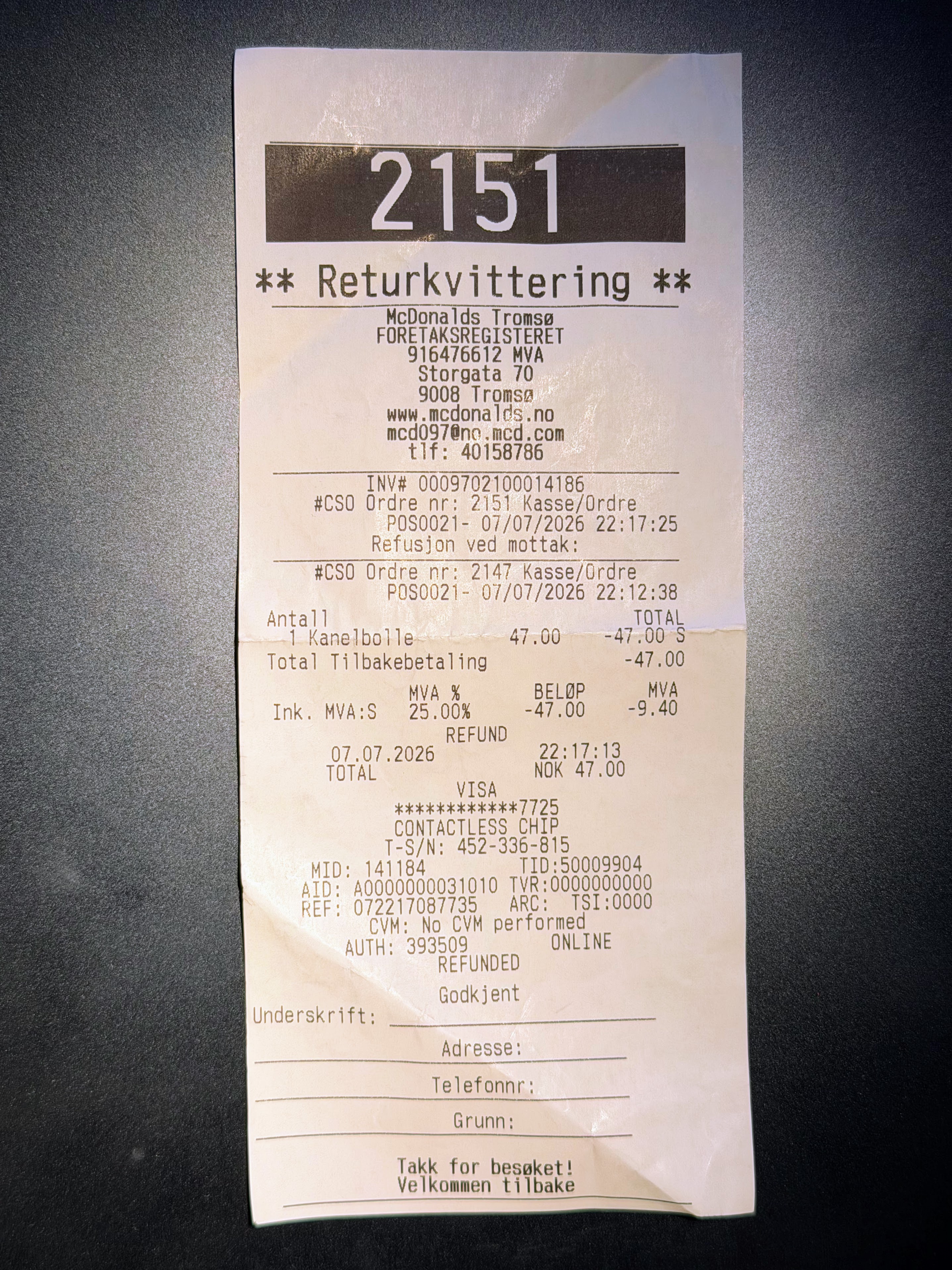
The paper refund receipt, photographed. Where the commemorative card is proof-of-visit sold as merchandise, the refund receipt is proof-of-visit produced accidentally, by the system’s own failure to deliver its product: a document of attention that consumed nothing, extracted nothing, and left nothing behind but the record of its own reversal. It is the study’s hero image and its only physical artefact — and it is a document that exists solely to certify that a transaction was undone. (The receipt was briefly unlocatable during drafting, during which interval the study’s sole artefact was itself absent; its provenance chain thus includes its own gap, which the author finds thematically appropriate and declines to apologise for.)
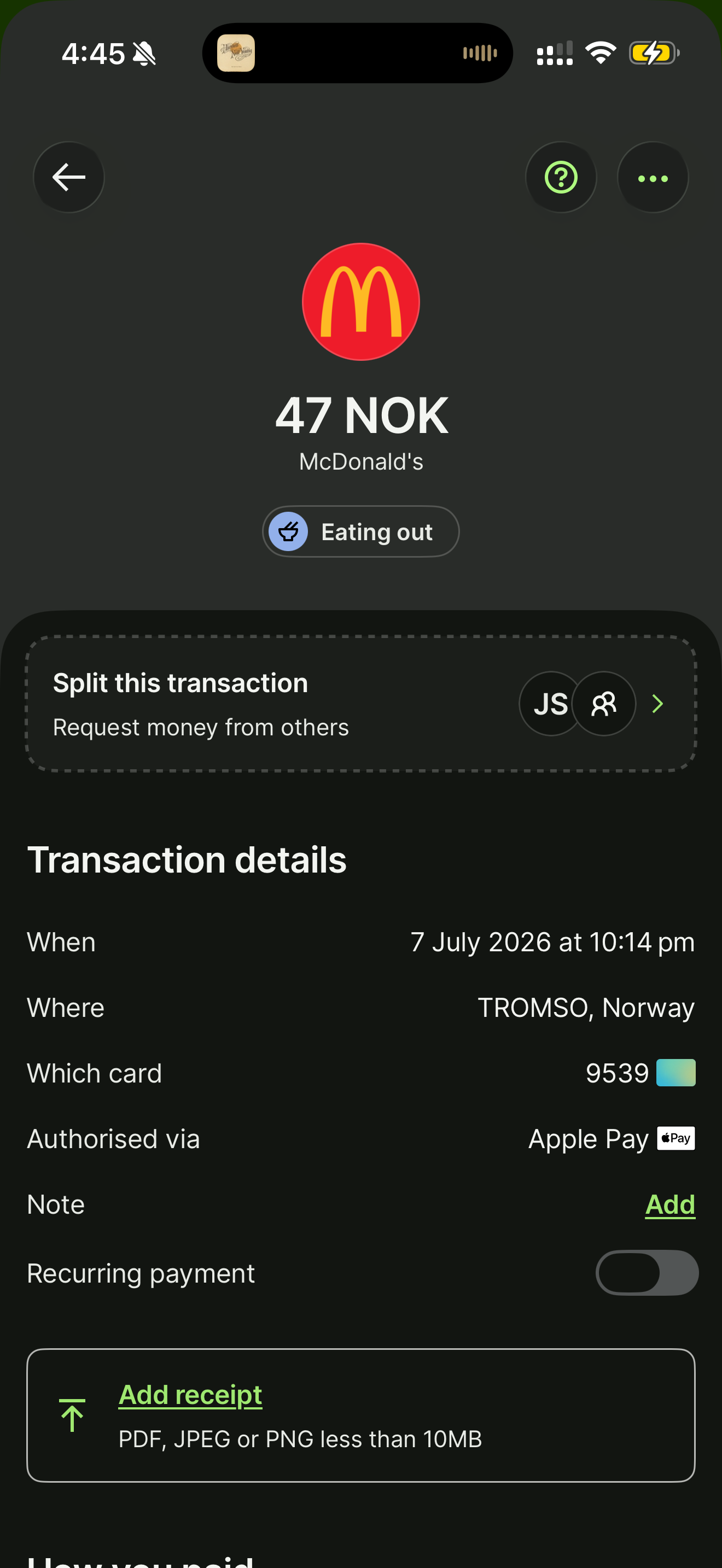
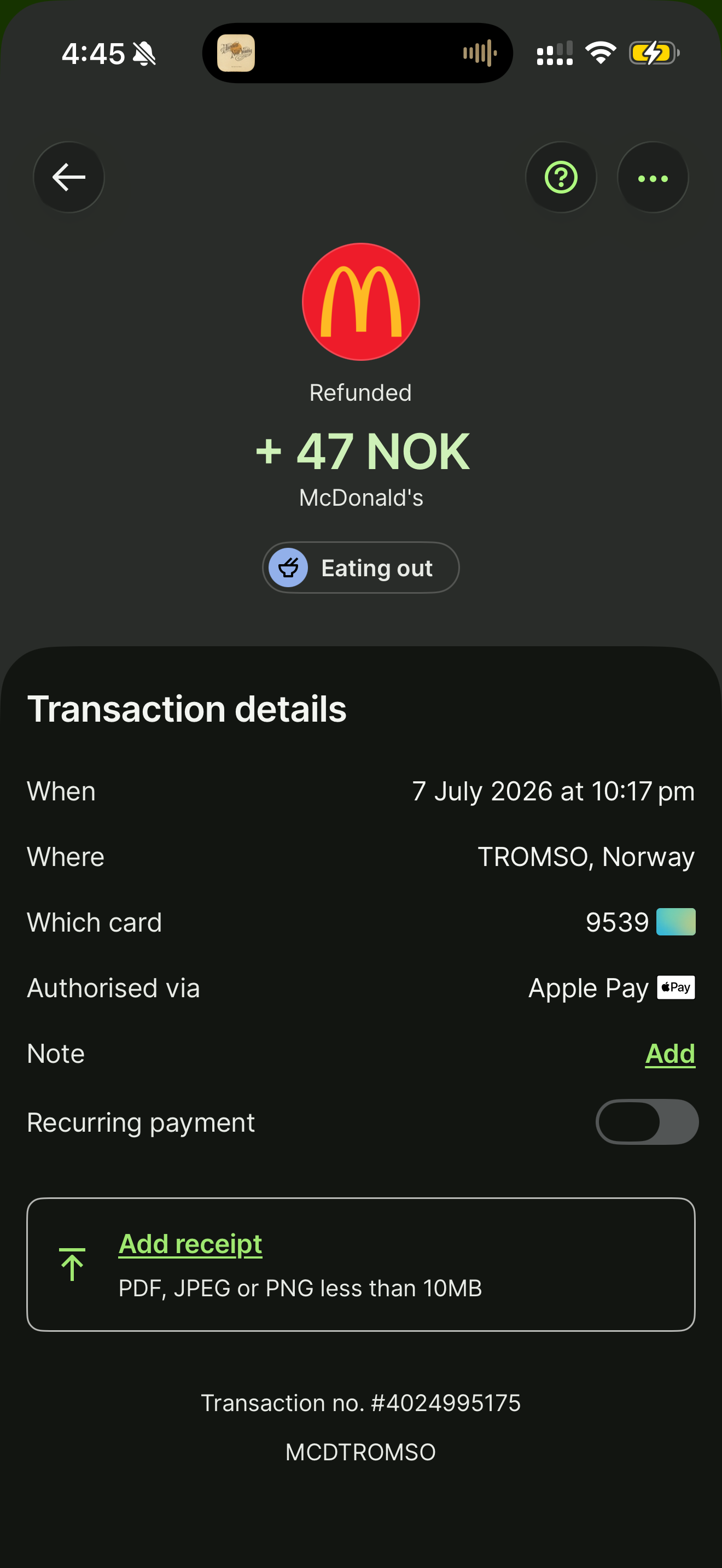
The transaction is independently attested by two entries in a Wise ledger: a debit of NOK 47 and a credit of NOK 47, three minutes apart, netting to zero. The purchase’s entire financial residue is bookkeeping symmetry — a completed exchange whose trace is two entries that cancel each other. Attention degree zero was theorised in Findings 1 as a property of the product; here it is achieved by the product’s absence, which is purer.
Limitations
One (1) participant-observer, n = 1, self-selected and admittedly the kind of person who looks up which franchise sits furthest north. The midnight sun makes all timestamps aspirational. The burger was tasted only at Site B and only once; the localised item singled out for formal test at Site A — the kanelbolle — was the one thing the supply chain declined to deliver, so the study’s sole refund attaches not to the placeless good but to its single concession to place.